The Man in the Iron Mask: The Prisoner Behind the Legend
A secret prisoner died in the Bastille in 1703. Contemporary records describe a velvet mask; the iron face and royal twin belong to the story’s later transformation.
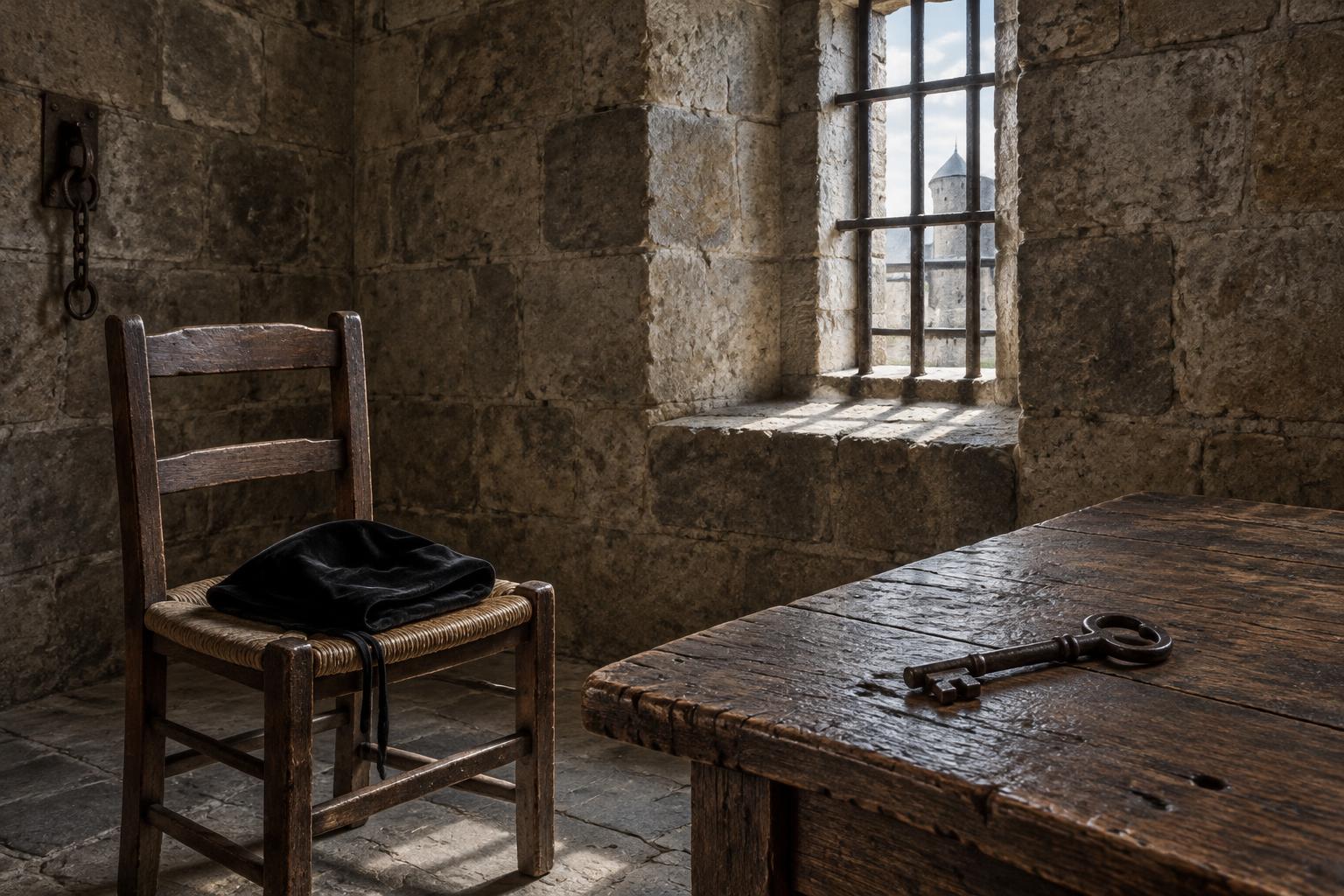
Illustrative reconstruction; not an archival photograph.
A death more certain than a name
The firmest ending to the story is not a rescue, an escape or a royal revelation. A prisoner died in the Bastille on November 19, 1703, and was buried under the name Marchioly, with variant spellings appearing in accounts of the record. The man’s custodians knew enough to administer his confinement. Later readers inherited enough information to recognize a mystery, but not enough to settle his identity.
The familiar image reverses that evidential balance. An iron face seems tangible; an anonymous life seems almost fictional. Yet the records are stronger evidence for a real detainee than for the metal covering that gave him his enduring name. Separating those two propositions is the first step toward understanding the case. It also prevents a highly effective literary image from silently becoming an eyewitness description.
1669: instructions for Eustache Dauger
The leading reconstruction begins with a July 1669 letter from the war minister, the marquis de Louvois, to the governor of Pignerol, Bénigne Dauvergne de Saint-Mars. A prisoner called Eustache Dauger was being sent into his custody. The instructions emphasized isolation and restrictions on speech, including a threat of death for speaking beyond his immediate needs. Dauger arrived that summer.
Such orders establish that the government wanted communication controlled. They do not identify what information the captive possessed. Nor does an administrative name necessarily disclose an entire biography. Historians must connect this early prisoner to later movements through correspondence, rather than simply assuming that every reference to an unusually secret detainee concerns the same man. That reconstruction is persuasive to many researchers, but the missing motive remains a separate problem.
Pignerol: secrecy without complete solitude
Pignerol, now Pinerolo in Italy, was then under French control. Its prisoners included Nicolas Fouquet, Louis XIV’s fallen finance minister. Accounts reconstructed from official correspondence place Dauger in service to Fouquet under controlled conditions. That detail complicates the popular picture of someone denied every human encounter for decades. He could be useful within the prison while remaining dangerous, in the authorities’ judgment, outside its walls.
Louvois described Dauger as a valet. Many historians have treated this as evidence of social position and as an objection to royal-birth theories: a hidden prince supposedly guarding a succession secret seems an unlikely choice to serve another detainee. But the wording has itself generated scholarly disagreement. A study published by Early Modern France argues for a wordplay interpretation rather than a literal occupational description. It is a proposed reading, not a consensus that dissolves the question.
1681–1698: following the jailer
Saint-Mars supplies the continuity in the story. He moved from Pignerol to Exilles in 1681, then to the island fortress of Sainte-Marguerite in 1687, and finally to the Bastille in 1698. The secret prisoner followed the same custodial trajectory in the standard reconstruction. The island imprisonment lasted eleven years, not the whole thirty-four-year span commonly attached to the case. Cannes’s municipal archives situate the episode within the actual history of the fort and its state prison.
These transfers matter because the mystery is administrative as well as personal. Keeping the man with a trusted governor reduced the number of people who needed instructions about him. It also created the documentary trail that makes modern identification possible. The trail demonstrates unusual continuity of supervision; it does not show that a mask was worn throughout every transfer, every meal or every year of imprisonment.
What the Bastille account actually describes
The Bastille official Étienne du Junca recorded Saint-Mars’s arrival in September 1698 with an old prisoner whose face was covered by a black velvet mask. This is the crucial contemporary description. A cloth covering, used to conceal a face, is different from an iron apparatus permanently fastened around a head. Historical transcriptions of the prison entries appear in Marius Topin’s nineteenth-century investigation, available through Project Gutenberg.
Topin is not a neutral modern edition: he advanced his own identification and wrote long after the events. His book remains useful for accessing reproduced documents, provided that a reader distinguishes the documents from his conclusions. The surviving description supports concealment on occasions when others might see the prisoner. It does not justify the claim that he spent 1669–1703 continuously masked. Those dates describe the proposed span of custody, not an established duration of mask-wearing.
How iron entered the legend
Reports of an iron mask circulated before the prisoner’s death, particularly around the later transfers. The legend was not invented in a single moment by one novelist. What changed afterward was its reach and narrative precision: a secret captive became a man with a mechanically distinctive face, then a possible royal relative whose identity could explain an entire political drama.
Voltaire helped popularize the mystery in the eighteenth century. Alexandre Dumas later gave the royal-double tradition its most enduring fictional form in the nineteenth-century musketeer sequence. These works belong to the history of the story, but they are not independent evidence of the prisoner’s parentage. The iron mask is therefore best understood as a developing legendary element, contrasted with the velvet specified in the Bastille account. A compelling narrative accumulated around a narrower and less visually spectacular documentary core.
Dauger and the missing reason
Eustache Dauger is the leading candidate because his appearance in 1669 and subsequent custodial history fit the reconstructed sequence. That is an argument about matching records. It leaves the harder questions open: was the name authentic, what had he done, and why did the government continue to confine him after the immediate circumstances of his arrest had passed?
Historian Paul Sonnino has argued that Dauger knew compromising information involving Cardinal Mazarin’s wealth and its connections with English royal interests. Reporting on Sonnino’s book presents this as an explanation for the government’s extraordinary precautions. It should remain attributed to him, rather than rewritten as a confession recovered from the prisoner. The distinction is essential: identifying a plausible detainee does not automatically establish the secret that detained him. Different scholars can agree about Dauger while disagreeing about what his captivity meant.
Matthioli and the danger of a similar name
Another major candidate is Ercole Antonio Matthioli, an Italian political intermediary imprisoned after dealings involving the fortress of Casale. His name resembles Marchioly, the name associated with the masked prisoner’s burial. That resemblance made him attractive to investigators who sought a straightforward identification in the death record.
Chronology is the obstacle. Matthioli entered French custody later than Dauger, and many historical reconstructions place his death in 1694, before the Bastille arrival and the recorded death in 1703. The competing theory therefore depends on resolving documentary inconsistencies, not merely noticing a similar surname. Burial names could be inaccurate, assumed or deliberately obscuring. Conversely, resemblance is not meaningless simply because it is inconvenient to a favored theory. Its value must be weighed against the entire sequence of prison movements and dates, rather than used as a single decisive clue.
Why the king’s twin remains fiction
A concealed brother or twin of Louis XIV would supply an immediately recognizable reason for secrecy: a rival claimant might threaten the monarchy. It also supplies the dramatic symmetry that historical mysteries rarely deliver. However, no surviving evidence securely establishes such a birth or connects a royal sibling to the detainee tracked through these prisons.
The theory’s emotional appeal cannot repair that gap. Elaborate precautions may imply that officials feared disclosure, but they do not tell us whether disclosure involved inheritance, espionage, finance, personal scandal or some other embarrassment. Reasoning backward from severe confinement to royal blood is therefore unsafe. The same caution applies to long lists of famous proposed identities. A candidate must fit the documents, the timeline and the conditions of custody. Fame, facial resemblance in later artwork and suitability for a film plot are not substitutes for those tests.
Reading a prison archive without a confession
The surviving evidence was created to administer imprisonment, not to explain it to posterity. Ministers needed secure cells, reliable guards and reports that instructions had been followed. Their correspondence could assume knowledge shared between sender and recipient. An order might therefore be precise about doors, speech or service while remaining silent about the original accusation. This is an important reason why abundant administrative detail can coexist with a missing explanation.
The documents also reach modern readers through editions and historical arguments. Topin reproduced letters and records while arguing for Matthioli. Other historians arranged much of the same material around Dauger. The identity of a published document and the identity proposed by its editor are separate matters. A useful reading records the document's date, author and immediate subject before considering the conclusion attached to it. Otherwise, an argument about the prisoner can begin to look like something the prison archive explicitly states.
The case consequently requires more than collecting unusual phrases. A single instruction may be striking without being unique to this prisoner, while an apparently routine reference may help connect two phases of custody. The strongest reconstruction uses a sequence of mutually compatible records rather than one dramatic sentence. It must also acknowledge where a connection is inferred. An unbroken narrative in a modern book is not necessarily an unbroken sequence of documents naming the same person at every stage.
The machinery of royal detention
The principal figures occupied different places in the hierarchy. Louis XIV was the sovereign under whose authority the confinement continued. Louvois supervised military administration and issued the crucial early instructions. Saint-Mars carried out custody at successive posts. Treating these men as interchangeable obscures how the evidence works. A minister's command tells us what the central government required; a governor's response tells us how he represented compliance. Neither automatically gives access to the captive's experience.
The movement between fortresses illustrates a detention system organized through trusted individuals. A prisoner could remain attached to a custodian even while the custodian's place of service changed. This is different from a modern assumption that each prison would receive a complete, accessible case file establishing the reason for detention. In this case, continuity of personal supervision helped preserve secrecy. It also meant that Saint-Mars's career became the framework through which later historians could follow the man.
The surviving record does not establish a public trial or a conviction explaining the decades of confinement. That absence should not be filled with an invented indictment. Nor does it mean the prisoner had no importance to officials: the sustained restrictions demonstrate that they treated his communication as a problem. What remains uncertain is the nature of that problem. The distinction between a government's fear and a historian's knowledge of its cause is central to the dossier. Official severity is evidence of official conduct, not proof that a particular alleged secret was true.
Fouquet's household inside the fortress
Nicolas Fouquet's presence gives the Pignerol phase a more complex human setting than the popular solitary-cell image. Fouquet had held high office before his fall and imprisonment. Within the fortress, service, household needs and restrictions on contact could exist together. The correspondence concerning Dauger's use as a servant therefore matters as practical evidence about what the authorities permitted. It suggests that secrecy was managed through controlled relationships rather than a complete ban on all interaction.
This is also where the existence of other prisoners and servants becomes important. Historical accounts discuss Fouquet's valet La Rivière alongside Dauger, and the duke of Lauzun was another prominent detainee at Pignerol. The documents must be read carefully to avoid transferring an instruction concerning one man to another. A governor with several captives could refer to them collectively or by shorthand. Later researchers then have to determine which person a particular phrase identifies, and whether a subsequent transfer concerns the same group.
Dauger's service has an obvious bearing on the royal-brother hypothesis, but it should not be exaggerated into a complete solution. A low-status role is difficult to reconcile with some versions of a secretly protected prince. It is easier to reconcile with a servant who knew something officials wanted concealed. Yet that comparison still leaves the secret unspecified. Establishing the kind of work a man performed in prison does not establish his earlier employer, the information he possessed or the original reason for his arrest.
After Fouquet: narrowing the chain
Fouquet died in 1680. His death changed the setting in which Dauger and La Rivière had been confined. The documentary problem after that point is to follow the remaining prisoners without assuming that every disappearance from correspondence means death or release. Topin's collection preserves the ministerial exchanges through which nineteenth-century investigators attempted to reconstruct these changes. References to paired prisoners and later to a single longstanding captive are important because they help narrow the possible chain.
This phase demonstrates both the strength and the limits of the Dauger identification. It is not based simply on a modern author's preference for an obscure name. It comes from comparing earlier confinement, permitted contacts and later references to custody under Saint-Mars. At the same time, not every link supplies a full name and biography. The inference is cumulative. A responsible account can call it the leading reconstruction while still explaining that the final Bastille record does not itself identify the dead man as Eustache Dauger.
The change from Pignerol to Exilles in 1681 therefore deserves its own place in the chronology. It was not merely a stop in an itinerary made famous afterward. It is one of the points at which researchers must connect the prisoners mentioned before and after a governor's move. Exilles also prevents the chronology from collapsing into a false direct transfer from Pignerol to Sainte-Marguerite. Those missing six years matter when testing candidates whose arrests or deaths fall at different points in the sequence.
An island prison, not an entire lifetime
Sainte-Marguerite lies off Cannes, and its Fort Royal supplies the best-known physical setting before the Bastille. Cannes's municipal archives place the masked-prisoner episode within the history of an actual state prison. That setting is not evidence for the identities later proposed by novelists. A surviving fortress can authenticate the place of confinement without authenticating every story told about a particular cell. Material continuity and biographical certainty are different kinds of evidence.
The standard chronology assigns the island phase to 1687–1698. This is long enough to become a substantial life chapter, but it is not equivalent to the full thirty-four years attributed to Dauger's custody. Popular retellings often move the entire captivity to one memorable site or let an illustration of an iron mask stand for every year. The documents require a more divided history: different places, changing administrative circumstances and a later explicit description of velvet concealment.
Secrecy during movement also posed a different problem from secrecy inside a cell. A transfer exposed a prisoner to guards, transport arrangements and possible onlookers. Concealing a face in such circumstances need not imply a permanently fitted device. Nor would the use of concealment automatically prove that everyone who saw the face would recognize it. Officials could wish to prevent identification, communication or rumor without dealing with a universally famous man. The purpose must be inferred cautiously rather than assumed from the existence of a covering.
September 1698: a new governor and an old captive
Du Junca's entry for 18 September 1698 is particularly valuable because it belongs to the receiving institution. Saint-Mars arrived as the new governor of the Bastille with an old prisoner from his earlier custody. The entry connects the Paris confinement to the governor's previous service. It does not supply a birth name, an accusation or a judicial sentence. Its contribution is narrower but firmer: a contemporary official recorded a specific arrival and the concealment of the prisoner's face.
The word old also needs care. In descriptions of this case it can refer to a longstanding prisoner as well as suggesting age. Estimates attached to the death and burial records do not provide a secure birth certificate. A candidate should not be accepted or rejected solely because one approximate age can be made to match. The broader sequence of custody is stronger evidence than an uncertain numerical estimate, especially when officials were not recording a transparent personal history.
The Bastille documentation is therefore an anchor rather than a universal key. It places the last phase on a firm chronological footing and preserves the velvet mask that later stories often replace. But an anchor does not repair every earlier link. The historical task remains to connect the prisoner who arrived with Saint-Mars to the men mentioned in earlier correspondence. That is why an argument based only on a burial-name resemblance is weaker than one that also explains the transfers and the governor's long relationship with his captive.
November 1703: the limits of the final entry
The record of death places the end on 19 November, with burial the following day at Saint-Paul. These details are reproduced in the documentary tradition discussed by Topin and in later summaries. They establish an ordinary administrative ending to an extraordinary confinement. There is no documented substitution, last-minute rescue or revelation in these entries. A writer who supplies one is moving into fiction, however closely the surrounding scene follows the known dates.
The burial name has nevertheless become one of the most argued pieces of evidence. Marchioly and related transcriptions resemble Matthioli, which gave Topin and other advocates of that identification an apparently concrete clue. But a name entered at burial need not be an independently verified birth name. The uncertainty is especially important in a case whose administrators had long avoided public identification. An obscure register entry can preserve information while still leaving unresolved whether it was accurate, mistaken or deliberately concealing.
No reliable personal testimony from the prisoner explains the meaning of that name. The absence is consequential: scholars cannot check an administrative label against his own account of family, occupation or arrest. The surviving story is overwhelmingly written by custodians and later interpreters. This imbalance should remain visible in the finished article. We know much more about the restrictions placed on the man than about how he understood them, and the documents do not authorize a reconstructed inner voice to compensate for that loss.
Voltaire's problem and Dumas's solution
Voltaire's treatment helped make the captive's identity a question about the monarchy itself. He wrote after the imprisonment, and the authority of his reputation should not be confused with eyewitness access to the prisoner's origins. His discussion belongs to an expanding eighteenth-century debate in which secrecy invited speculation about concealed royal relationships. The fact that a celebrated writer believed a possibility worth discussing does not turn that possibility into a contemporary admission by the crown.
Dumas went further in a different genre. In the musketeer narrative, a royal double makes the mystery function as a plot: the hidden face can explain a disputed identity, a possible substitution and a challenge to royal power. This is a literary solution because it supplies precisely the motives and private knowledge the archival record lacks. Its effectiveness depends on narrative coherence, not on the discovery of a document establishing an otherwise unknown twin birth.
The distinction does not diminish the cultural importance of the novel. Later stage and screen versions helped determine what audiences expected the historical case to contain. The result is an inversion in which a hypothesis becomes familiar first, and the evidence is then asked to support it. A historical account should reverse that process. The prison records set the limits; fiction explains why some imagined answers became more memorable than others. Cultural influence is itself documentable, but it cannot be counted as corroboration of the imagined identity.
Motive theories and the burden of proof
Sonnino's proposed financial explanation is one attempt to connect Dauger with a specific political danger. Its interest lies in moving away from royal resemblance and toward information that a relatively obscure person might possess. That change makes secrecy intelligible without requiring royal blood. It does not remove the need to demonstrate the relevant relationships. A plausible world of financial and diplomatic intrigue can supply a context without establishing that this particular captive carried the decisive information.
Matthioli offers a different kind of attraction: an identifiable political intermediary whose arrest arose from dealings over Casale. The difficulty is not the absence of a possible motive for confinement. It is matching his history to the whole custody sequence and to the prisoner who reached Paris. The competing hypotheses thus solve different parts of the puzzle with different degrees of success. One must not let a strong explanation for arrest outweigh an incompatible chronology, or let chronological fit stand in for proof of motive.
The same discipline applies to the possibility of an assumed name. A false administrative identity could explain why a biography is hard to recover, but it can also become an unfalsifiable escape route for a weak theory. If every inconvenient record is dismissed as deliberate deception, no candidate can be tested. A useful hypothesis must say which records it treats as reliable and explain why. The remaining uncertainty is not permission to make all surviving evidence equally doubtful; it is a reason to identify the precise points where knowledge ends.
What remains behind the mask
The strongest account is both less theatrical and more disturbing than the familiar legend. A man probably identifiable as Eustache Dauger spent decades in state custody, remained attached to one jailer’s career and eventually died in the Bastille. Contemporary evidence describes velvet concealment, while the image of permanent iron belongs to a developing tradition. The reason for his imprisonment is still disputed.
This is not a case in which every explanation has equal weight. Dauger’s documentary fit is stronger than the unsupported royal twin. But neither should uncertainty be removed simply because a coherent reconstruction is available. The responsible conclusion preserves different confidence levels: the prisoner and his death are well attested; the chain of identity is historically argued; the precise secret remains unproven. Behind the famous mask was a life restricted by royal power, and a surviving record too narrow to return that life whole.
Sources & record
- 01Cannes municipal archives: 1687–1698, le masque de fer ou de velours
- 02Marius Topin, The Man with the Iron Mask (1870): documents and historical argument
- 03Evan Andrews, HISTORY: Who was the Man in the Iron Mask?
- 04Justin and Stephanie Pollard, History Today: Death of the Man in the Iron Mask
- 05Early Modern France: The Valet, competing interpretation of Louvois’s letter
- 06Erik Shilling, Atlas Obscura: Paul Sonnino’s proposed identification and motive
Online citations
- →Cannes municipal archives: 1687–1698, le masque de fer ou de velours
- →Marius Topin, The Man with the Iron Mask (1870): documents and historical argument
- →Evan Andrews, HISTORY: Who was the Man in the Iron Mask?
- →Justin and Stephanie Pollard, History Today: Death of the Man in the Iron Mask
- →Early Modern France: The Valet, competing interpretation of Louvois’s letter
- →Erik Shilling, Atlas Obscura: Paul Sonnino’s proposed identification and motive