The Watcher: A Family Bought Their Dream Home. Someone Was Already Watching It
In June 2014, Derek and Maria Broaddus closed on a six-bedroom house at 657 Boulevard in Westfield, New Jersey, for about $1.3 million. Three days later, before the family had even moved in, a letter arrived addressed to 'The New Owner'. It welcomed them to the neighborhood — and then explained that the house had been the subject of the writer's family for decades, that it was now the writer's turn to watch, and that the writer had been asked to watch the house and was waiting for its 'second coming'. The letter was signed 'The Watcher'. More followed. The sender has never been identified.
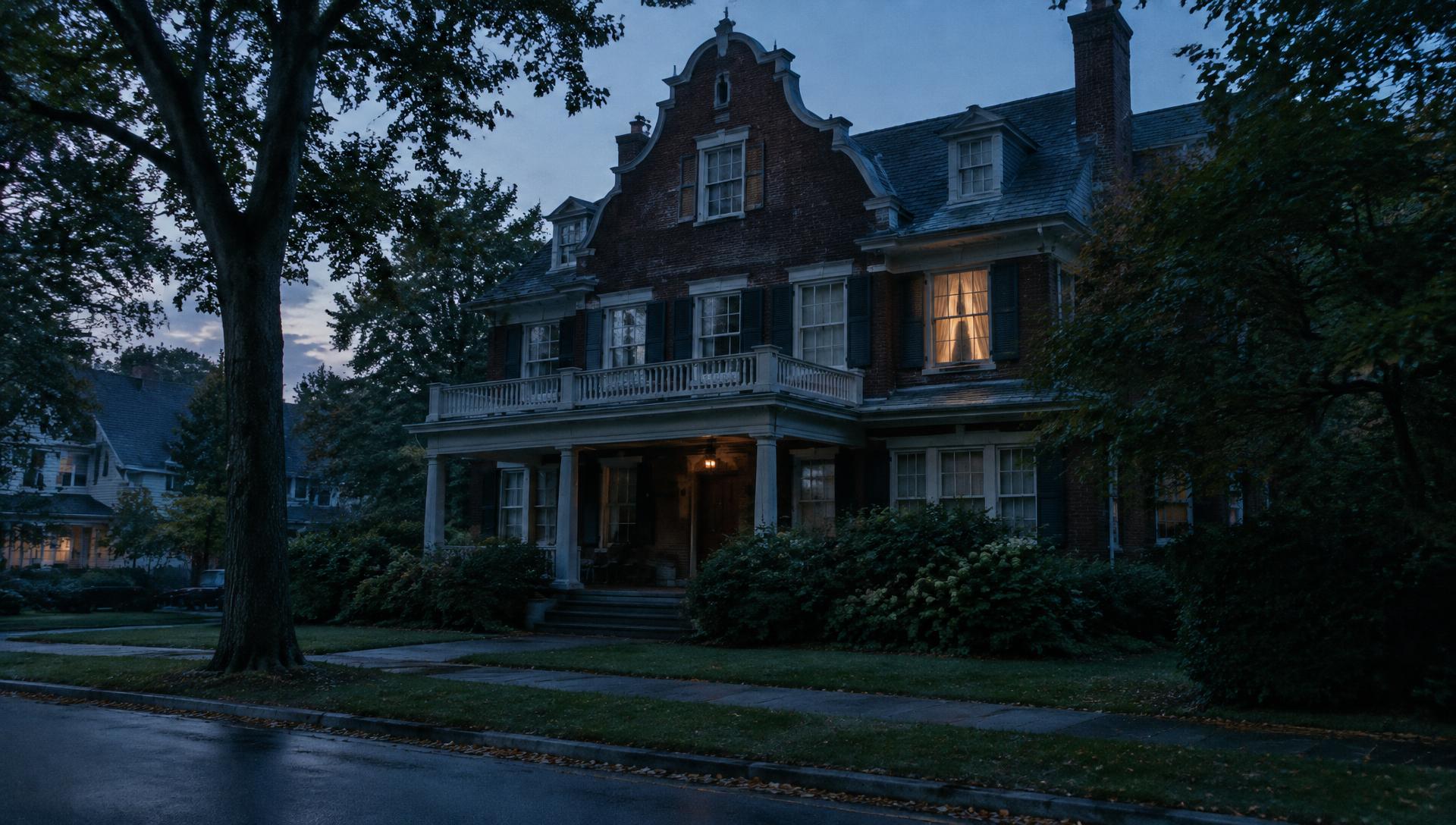
Illustrative reconstruction; not an archival photograph.
Westfield is the kind of town people move to precisely because nothing happens there — a leafy, affluent commuter suburb about 45 minutes from Manhattan, regularly listed among the safest towns in New Jersey. The house at 657 Boulevard was a 1905 Dutch colonial revival with six bedrooms on a manicured street, and Derek and Maria Broaddus, who already lived in town with their three young children, saw it as the culmination of years of work. Maria had grown up in Westfield; the house stood a few blocks from her childhood home. They closed in June 2014 for about $1.3 million and began renovations before moving in. The house stood empty. The first letter arrived three days after closing.
What the letters said
The first letter, dated 18 June 2014, was addressed in thick, clunky handwriting to 'The New Owner' and began warmly enough — 'Dearest new neighbor at 657 Boulevard, allow me to welcome you to the neighborhood.' Then it turned. The writer claimed the house had been watched by their family for decades: a grandfather had watched it in the 1920s, a father in the 1960s, and now, the letter said, it was the writer's time. The writer described being 'in charge' of watching and waiting for the house's 'second coming', and asked whether the new owners knew what lay within its walls.
Two more letters followed over the next weeks, and they demonstrated close, current observation. The writer knew the family had three children, referenced them by name and birth order, and called them 'young blood'. One letter asked whether the children would play in the basement, and whether the parents knew what was hidden down there. Another noted the contractors and the renovation work in detail, and described seeing the family's youngest child at an easel in a room on the side of the house — a detail that implied the writer could see inside. One passage read, in part, that once the writer knew the children's names, the writer would 'call to them and draw them to me'. The letters were typed, hand-addressed, and carried no return address.
The family goes to the police
The Broadduses contacted the Westfield police within days of the first letter, and the Union County Prosecutor's Office joined the investigation. The letters were tested for fingerprints and DNA; reporting later indicated that DNA recovered from one envelope was female — one of the few concrete leads ever made public. Investigators canvassed the neighborhood and looked at anyone with knowledge of the house and the sale, which had not been publicly listed. The speed of the first letter — arriving within days of a private closing — told detectives the writer either knew the sellers, knew the buyers, or was watching the house closely enough to see it change hands.
Attention briefly settled on a family living nearby. One member was regarded by some neighbors as peculiar and had been seen sitting on a porch with a sightline to 657 Boulevard; police interviewed him and searched, but found nothing tying him to the letters. No one was ever charged. A complicating factor, noted in later reporting, was that the letters — for all their menace — contained no explicit threat of physical violence, which sharply limited what prosecutors could charge even if a writer were identified.
The lawsuit and the demolition plan
In 2015 the Broadduses sued the previous owners, John and Andrea Woods, arguing the Woods had known about the Watcher and failed to disclose it: the Woods had themselves received a letter days before the closing. The Woods said they had received only one letter, had dismissed it as a prank, and had lived at 657 Boulevard for more than two decades without incident. The suit drew national attention and was eventually settled on undisclosed terms.
Trapped with a house they feared and could not sell without disclosing the letters, the family applied to demolish it and split the lot into two buildable parcels — a plan that would have recouped their losses and, not incidentally, destroyed whatever the Watcher claimed to be watching. In early 2017 the Westfield planning board rejected the application after neighbors objected. The letters, meanwhile, had not stopped: a renter who moved in received another one in 2017, darker in tone, in which the writer described the house as the subject of a lifelong obsession and asked what the new occupants had done to deserve its attention.
Theories
With no arrest, the case settled into several standing theories, none proven. The most common holds that the writer is a neighbor — someone who knew the house's history, could watch it daily, and either objected to the renovation or wanted the house for themselves. A second suggests an older person with a genuine, decades-long fixation, matching the letters' claim of a family tradition of watching stretching back to the 1920s. A third, raised by some investigators and hotly denied by the family, is that the letters could have been connected to the buyers themselves as part of a financial or insurance maneuver; no evidence supporting that has ever surfaced. There is also the possibility that the whole affair began as a prank that escalated — the Woods' single pre-sale letter fits that reading — though it explains neither the detail nor the persistence.
What happened to the house
The Broadduses never spent a night in the house. They rented it out, carried the mortgage and the stigma for five years, and finally sold in 2019 for about $959,000 — a loss of roughly $400,000, before counting renovation and legal costs. The story had by then become famous: Reeves Wiedeman's 2018 New York magazine feature, 'The Watcher', was read worldwide, and in 2022 Netflix released a Ryan Murphy series dramatizing the case. The new owners have not reported receiving letters. Whoever wrote them knew the house, the sale, the children and the work crews — and stopped, or simply went quiet, before anyone could learn their name.
Sources & record
- 01Reeves Wiedeman — 'The Watcher', New York magazine / The Cut (2018)
- 02Westfield police and Union County Prosecutor's Office statements, as reported
- 03NJ.com / Star-Ledger — court and planning board reporting
- 04Court filings in Broaddus v. Woods (2015)
Online citations